

Refokus
Boutique agency that combines human creativity and AI to deliver sleek, strategic websites for ambitious startups.

Mission Control
Remote-first branding & web studio “born in the AI age,” senior team with async model for early-stage companies.

Habitat
Data-driven digital agency that feels like an in-house team, designing web, product, and brand experiences.
Together Agency
Global design and technology agency specializing in shaping brands, websites, and products for ambitious B2B tech companies, with a focus on behavioral science and user-centric design.
Brightscout
Austin-based B2B branding, web, and app development agency known for transforming innovative tech companies into market leaders.
Widelab
Product design & web/dev studio delivering UX/UI, branding, and Webflow/website builds for scaleups and SaaS. Portfolio highlights include Hopin, Trolley, Traba.
Halo-Lab
Full-stack design & development team (155+ noted across service pages) delivering UI/UX, web/apps, CRM & analytics.
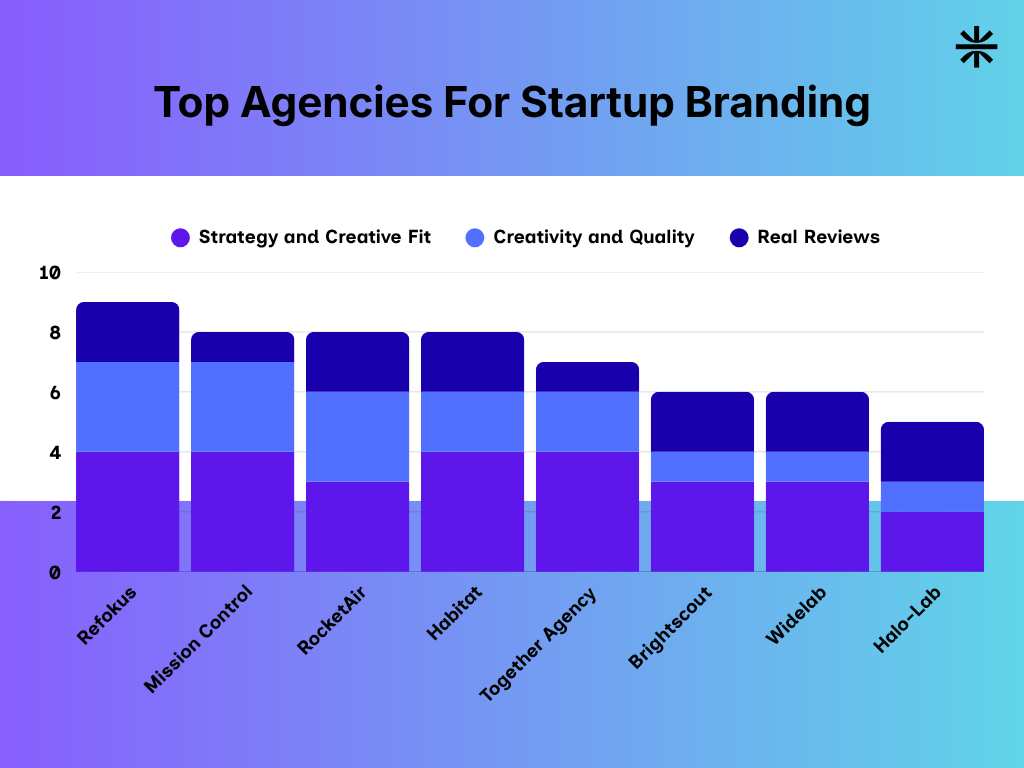
How We Evaluate Agencies
Here’s how we break down our agency ratings – it’s a 10-point system split across three main areas:
Strategy and Creative Fit (4 Points)
Does the portfolio show clear strategic thinking? We’re looking at whether their creative work actually solves business problems.
Creativity and Quality (3 Points)
This is about craft. How original is the work? Is the execution solid? We look at everything from visual polish to conceptual thinking.
Reviews and Feedback (3 Points)
What are clients actually saying? We dig into testimonials, ratings, and any public feedback we can find to see if they actually walk the walk.
Top Agencies For Startup Branding, Positioning, And Launch Systems
1. Refokus
Author opinion: “Refokus does some of the sharpest Webflow work I’ve seen at this level — the sites are fast, well-structured, and hold up visually against much bigger budgets. Where they’re less suited is when a startup needs brand strategy or identity built from scratch before touching the website. Come in with your positioning figured out and they’ll execute it beautifully.”
Best for: Startups and growing companies looking for Webflow-based websites that combine speed, creativity, and technical excellence.
Clients: Rainfall, Brightwave, GoodRoots, Cula, Analog Way, Arqitel, Deepset, Chargeflow, Josys
Offices: New York
Team Size: Under 50
Budget: $25,000+
Portfolio / Case Studies: https://refokus.com/work
Con: If you’re coming in without a clear brand identity or messaging foundation, Refokus isn’t the place to build it — their strength is in digital execution, not upstream brand strategy.
Trusted Review Sources:
Clutch — Feedback highlights design quality and fast delivery.
DesignRush — Consistent positive feedback on web design and Webflow projects.
Strategy and Creative Fit: 4 / 4 — Strong at translating an existing brand into a high-performing digital presence, with clear strategic thinking behind every build. The Webflow expertise isn’t just technical — it shapes how messaging and hierarchy land on the page.
Creativity and Quality: 3 / 3 — Consistently sharp visual and technical output. Work looks distinctive across their client roster and performs well — not just pretty to look at.
Reviews and Feedback: 2 / 3 — Positive feedback where it exists, spread across platforms. Volume is growing but not yet at the level where you can draw broad conclusions.
Total Score: 9/10
2. Mission Control
Author opinion: “Mission Control is one of the few agencies I’d point an early-stage founder to without hesitation — senior-led, fast, and built around the specific pressures of a pre-launch timeline. That said, they launched in 2025, so if you need an agency with a long client history behind them, this isn’t the right fit yet.”
Best for: Early-stage startups wanting fast, senior branding and web with an AI-accelerated process.
Clients: Early-stage and VC-backed tech startups
Offices: Remote (based in San Francisco)
Founded: 2025
Team Size: 11–50
Budget: Flexible
Hourly Rate: $150/hr
Con: Launched in 2025, so there’s no long client history to lean on. Not the right call if a proven track record matters to your stakeholders.
Trusted Review Sources:
Awwwards — Honorable Mention for Mission Control, recognizing design quality and execution.
The Brand Identity — Featured interview covering Mission Control’s approach and positioning for AI-age startups.
Strategy and Creative Fit: 4 / 4 — Senior-led from day one, which means strategic thinking is built into the process rather than bolted on. The AI-accelerated model speeds up execution without cutting the decisions that actually shape a brand.
Creativity and Quality: 3 / 3 — Early output shows strong craft and a visual sensibility that reads as credible and current for VC-backed companies. The work doesn’t look like it came from a template.
Reviews and Feedback: 1 / 3 — Launched in 2025, the reviews will come. Right now there isn’t enough public feedback to score this fairly against more established agencies.
Total Score: 8/10
3. RocketAir
Author opinion: “RocketAir has figured out something most agencies haven’t — that motion and narrative aren’t add-ons, they’re often the fastest way to make a complex product actually land with an audience. Still a relatively short client list, which makes it hard to know how they perform outside their current sweet spot.”
Best for: VC-backed startups and enterprises needing systematic design and motion to scale digital experiences.
Clients: Coursera, QED Investors, Qlik, Software AG
Offices: New York, USA
Team Size: Under 50
Portfolio / Case Studies: https://rocketair.co/work
Con: The client list is still building — enough to show they can do the work, not yet enough to know how consistently they do it across different sectors and budgets.
Trusted Review Sources:
Clutch — Reviews reference strong creative quality and collaborative process.
DesignRush — Positive feedback on motion design and digital brand work.
Strategy and Creative Fit: 3 / 4 — Motion and storytelling are used as strategic tools, not decoration. Good at making complex product value clear quickly, though broader brand strategy work is less evidenced.
Creativity and Quality: 3 / 3 — Strongest creative output on this list for motion and narrative. Work has a distinct visual voice that holds up across the portfolio.
Reviews and Feedback: 2 / 3 — Positive feedback where it exists, but the smaller client base means less volume of independent reviews than more established agencies.
Total Score: 8/10
4. Habitat
Author opinion: “Habitat’s embedded model is what sets them apart — they’re not a vendor you brief and wait on, they’re a team that thinks alongside you. The client roster is impressive enough that the limited public reviews feel like a gap worth noting, not a red flag.”
Best for: Startups or product companies needing design partners who integrate deeply with their teams.
Clients: AngelList, Hopin, Streamyard, Fendi, OPPO, SPAR, PAUSE, littlespoon
Offices: Rivne, Ukraine
Portfolio / Case Studies: https://www.habitat.agency/work
Con: Public reviews are thin relative to the calibre of clients they’ve worked with — you’ll want to speak to a past client directly rather than rely on what’s available online.
Trusted Review Sources:
Clutch — Reviews reference close collaboration and strong product design thinking.
DesignRush — Positive feedback on embedded design partnerships and product work.
Strategy and Creative Fit: 4 / 4 — The embedded model naturally aligns design decisions with product and business goals over time. Strong for iterative, outcome-focused work — less suited to one-off projects that need fast, defined delivery.
Creativity and Quality: 2 / 3 — Clean, well-considered product and brand design across an impressive client list. Doesn’t position itself as a creative-led agency, and the work reflects that — in a good way for the right brief.
Reviews and Feedback: 2 / 3 — Strong client names suggest earned trust. Independent public review volume is lower than the roster would suggest, which is worth factoring in.
Total Score: 8/10
5. Together Agency
Author opinion: “Together thinks about B2B brand and product as one problem, not two separate briefs — and that shows in how coherent the final work feels across touchpoints. The client list is focused rather than broad, so if you’re outside B2B tech, you’ll want to look elsewhere.”
Best for: B2B tech companies seeking strategic design and technology solutions.
Clients: Pydantic, Diffblue, Trullion, Astra, Stytch, Rainforest
Offices: London, UK
Portfolio / Case Studies: https://together.agency/work
Con: Primarily built for B2B tech — if your startup sits outside that space, another agency will understand your market and audience better.
Trusted Review Sources:
Clutch — Reviews note strong collaboration and UX expertise.
DesignRush — Consistent positive feedback on strategy and digital design.
Strategy and Creative Fit: 4 / 4 — Positioning, product experience, and brand systems are treated as connected problems. Strategic thinking is evident in how they frame and scope client engagements.
Creativity and Quality: 2 / 3 — Clean, professional execution well suited to B2B audiences. The work prioritises clarity and system coherence over bold creative differentiation.
Reviews and Feedback: 1 / 3 — The work quality is clear from the portfolio, but independent public reviews are sparse. More client voices would go a long way here.
Total Score: 7/10
6. Brightscout
Author opinion: “Brightscout is a solid one-stop shop for B2B startups that need branding, web, and product delivered by the same team. The work is commercially grounded and reliable — just don’t come here expecting a brand that breaks category conventions.”
Best for: B2B tech companies looking to establish strong brands and digital products that drive market leadership.
Clients: Predibase, Galileo, Halcyon, Arch/Meltano, Trinsic, Mistral, ATA Offices: Austin, USA
Budget: $25,000+
Portfolio / Case Studies: https://brightscout.com/work
Con: Creative output stays within safe visual territory for B2B — the right choice for a polished, credible presence, but not if you want to look like nothing else in your category.
Trusted Review Sources:
Clutch — Clients highlight delivery quality and reliable project management.
DesignRush — Positive feedback on branding and web projects for tech companies.
Strategy and Creative Fit: 3 / 4 — Brand and digital work is clearly tied to commercial goals. Execution follows a solid strategic brief, though the strategy itself rarely becomes a point of differentiation.
Creativity and Quality: 1 / 3 — Consistent and professional, but the work rarely surprises. If looking distinctive in a crowded category matters to your brief, this probably isn’t the right fit.
Reviews and Feedback: 2 / 3 — A reasonable number of positive reviews across platforms, with clients noting smooth delivery and solid results.
Total Score: 6/10
7. Widelab
Author opinion: “Widelab punches above its price point for SaaS brands that need a clean, conversion-focused site shipped fast. The lower hourly rate reflects their Polish base, not a drop in quality — but if you need a brand identity built from the ground up, start somewhere else first.”
Best for: Venture-backed SaaS and marketplaces needing fast, user-tested UX and Webflow design that ships quickly.
Clients: Diesel, WeWork, Hopin, Fitch Ratings
Offices: Gdańsk, Poland Founded: 2017
Budget: $5,000+
Hourly Rate: $50–$99/hr
Portfolio / Case Studies: https://widelab.co/work
Con: Prioritises clarity and conversion over brand differentiation — the right call for many SaaS briefs, but not the agency to call when standing out visually is the primary goal.
Trusted Review Sources:
Clutch — Clients highlight fast turnaround and strong Webflow delivery.
DesignRush — Consistent positive feedback on UX and web design for SaaS companies.
Strategy and Creative Fit: 3 / 4 — UX thinking is strong and clearly informs the design. Best suited to teams that arrive with their positioning already defined rather than those still working it out.
Creativity and Quality: 1 / 3 — Functional and well-built, but creative ambition is limited. Widelab ships fast and clean — if you need a site that converts, that’s enough. If you need one that turns heads, look elsewhere.
Reviews and Feedback: 2 / 3 — Founded in 2017, they have a reasonable review footprint. Feedback is generally positive with consistent mentions of delivery speed and communication.
Total Score: 6/10
8. Halo-Lab
Author opinion: “Halo-Lab makes sense for early-stage startups that need one team covering brand, product, and build without a large agency budget. The breadth is real — just make sure you confirm who’s leading the work on your project before you sign, because at this price point, seniority on individual projects can vary.”
Best for: Startups and SMBs wanting cost-efficient UX/UI and engineering at scale with ongoing analytics and CRM support.
Clients: Databest, 46 Labs
Offices: Dubai
Founded: 2013
Hourly Rate: $25–$49/hr
Portfolio / Case Studies: https://www.halo-lab.com/portfolio
Con: At this price point and service breadth, senior creative involvement isn’t guaranteed across every project — worth a direct conversation about who leads your work before committing.
Trusted Review Sources:
Clutch — Reviews note breadth of services and responsive communication.
DesignRush — Positive feedback on UX/UI and development work for startups.
Strategy and Creative Fit: 2 / 4 — Wide service breadth, but strategic depth varies depending on the project and team assigned. Better used as an execution partner than a strategic one.
Creativity and Quality: 1 / 3 — Output is competent and covers a lot of ground, but creative seniority isn’t consistent at this price point. The work gets the job done without leaving a strong impression.
Reviews and Feedback: 2 / 3 — Over a decade in business gives them a solid review footprint. Public feedback is generally positive, though concentrated across a limited number of platforms.
Total Score: 5/10
What Makes Brand Design for Startups Different
Startup branding isn’t corporate branding at a lower budget. The constraints are different, the stakes are different, and so is what the work needs to do.
You’re building trust before you have proof.
Established companies lean on reputation. Startups don’t have that. Every visual decision — color, type, how your website feels — has to signal credibility before a single customer has validated you. The brand does the convincing on its own.
The brand has to reflect a point of view.
Corporate identity is built to be neutral and durable. Startup brands work best when they’re opinionated — built around a specific belief, for a specific audience. Trying to appeal to everyone at this stage is a fast way to resonate with no one.
Flexibility matters more than polish.
Your positioning may shift after your first hundred customers. Your audience might turn out to be slightly different from who you assumed. Good startup brand design accounts for that — a visual system that can stretch and adapt without requiring a full rebrand every time the strategy evolves.
Speed is part of the brief.
A large company can spend a year on a rebrand. Startups rarely have that runway. The agencies best suited to this work have built processes that move fast without skipping the strategic thinking that makes design hold up.
How Much Does Startup Branding Cost?
Startup branding ranges from $2,000 to $150,000+. That’s not vagueness — it reflects genuinely different scopes, processes, and outcomes. Knowing what you’re buying at each level matters more than finding the lowest price.
Logo only: $2,000–$10,000.
You get a wordmark or mark, a few variations, and basic file formats. Some agencies include a one-page usage guide. This is the right level for pre-seed startups that need something credible for a pitch deck before the positioning is locked in. Treat it as a placeholder, not a foundation.
Full brand identity: $15,000–$50,000.
This covers logo, typography, color palette, iconography, photography direction, and a brand guidelines document. Better agencies at this tier also do strategic groundwork first — competitive analysis, audience definition, positioning — before touching design. Expect six to twelve weeks and two to three rounds of concepts. This is the right investment from seed stage onward, once you have a clear product and a customer you’re designing for.
Brand strategy + identity + design system: $50,000–$150,000+.
At this level, you’re buying a complete brand architecture — verbal identity, messaging hierarchy, design system, website direction, and templates. The agencies working here treat brand as a business problem, not a design problem. Most appropriate for Series A companies preparing to scale, or startups doing a formal rebrand ahead of a major launch.
Red flags worth knowing.
An agency offering a “full identity” for $3,000 is either templating the work or dramatically cutting scope — confirm deliverables in writing before signing. Any agency that skips discovery and jumps straight to concepts is designing without enough information. And always confirm you receive full IP ownership and editable source files at handoff. If that’s unclear going in, make it clear.
Frequently asked questions
Clay leads for premium brand plus product-grade UX and web. Mission Control is best for fast, senior-led brand and site launches. Refokus, Widelab, and Brightscout are strong when the website and product experience drive growth. Together Agency and RocketAir fit teams that need sharper positioning and narrative for complex products. Halo-Lab and Habitat work well for ongoing, embedded execution across brand, product, and build.
Speed and focus. Startups need fast clarity, a strong point of view, and a system that can evolve without constant redesign.
Positioning and messaging, visual identity, brand guidelines, website direction, and templates for pitch, sales, and hiring.
Often around launch, fundraising, or a major product shift. It is also useful when messaging is inconsistent and growth stalls.
Yes. A strong narrative and visual system improves pitch decks, credibility, and the way talent perceives your mission.
Costs vary by scope. Many projects range from mid five figures to six figures for strategy, identity, and rollout support.
A focused brand sprint can take 3 to 6 weeks. A full strategy, identity, and rollout often takes 8 to 14 weeks.
Look for strong positioning work, clear process, speed, and examples of startup brands that feel confident and distinct.
Often yes. Doing both together keeps the story consistent and avoids retrofitting the system later.
We prioritize clarity, pace, craft, and evidence the work supports real launches, growth, and credibility.
Read More
Browse our curated shortlists, compare reviews, and find the right partner for your next brand launch or refresh.
Best Web3&Crypto Branding Agencies
Discover agencies that build trust and clarity for emerging financial technologies.
Top Branding Agencies for Fintech Companies
Explore top branding agencies for fintech products, from financial platforms to modern banking.
Best San Francisco Branding Agencies
Explore agencies built around product-led storytelling and founder-driven narratives.
Best Brand Design Agencies in the World
Browse our list of brand design agencies from around the world.
Contact Info
Let’s Chat
Need help choosing the right agency?