Posts from July 16, 2026

Day: July 16, 2026

  • Questions to Ask a Branding Agency (and How to Read the Answers)

    Questions to Ask a Branding Agency (and How to Read the Answers)

    Most guides hand you a list of questions. That’s the easy half. The hard half is knowing what a strong answer sounds like, which questions to ask when you only have thirty minutes, and where a standard contract quietly fails — including one clause that can leave you not owning the logo you paid for. This page is built for that half.

    One number sets the stakes: businesses that skip proper trademark clearance face average rebranding costs of $50,000 to $500,000 when conflicts emerge post-launch. The right questions, asked early, are the cheapest insurance in this process. 

    The core questions, and which to ask first

    You won’t ask twenty questions in a first call and still have time to listen. If you only have one call, ask the five marked ⚡ — each is built so a weak agency disqualifies itself. Below is the full set, with what a strong answer includes and the evasion to listen for.
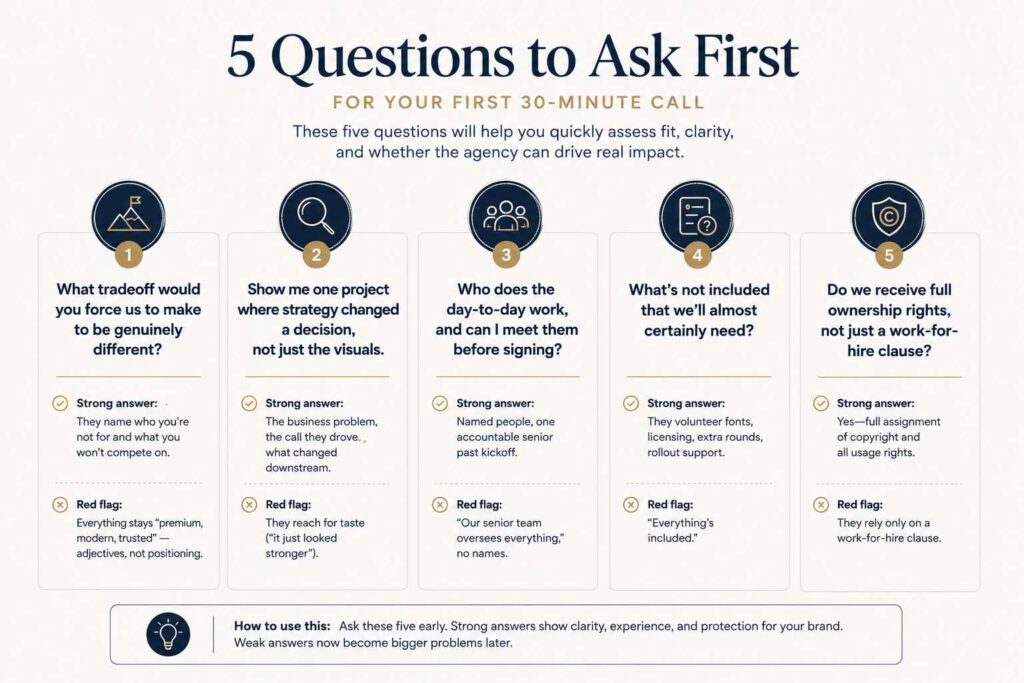
    5 questions to ask first your branding agency - Infographics

    Strategy and differentiation

    • “What tradeoff would you force us to make to be genuinely different?” Strong: they name who you’re not for and what you won’t compete on. Tell: everything stays “premium, modern, trusted” — adjectives, not positioning.
    • “What do you research first, and what decision does it unlock?” Strong: a sequence — category map, customer interviews, then positioning options with tradeoffs. Tell: “We explore the brand and see what emerges.”
    • “Show me one project where strategy changed a decision, not just the visuals.” Strong: the business problem, the call they drove, what changed downstream. Tell: they reach for taste (“it just looked stronger”).

    Process, timeline, scope

    • “Walk me through your phases and what we receive at the end of each.” Strong: three to six phases, a named deliverable per phase, defined approval gates. Tell: “We have a flexible process,” or “unlimited revisions” — a sign scope and decision rights are undefined, which is how timelines and budgets drift.

    Team and accountability

    • “Who does the day-to-day work, and can I meet them before signing?” Strong: named people, one accountable senior past kickoff. Tell: “Our senior team oversees everything,” no names — expect a handoff to juniors.

    Pricing and ownership

    • “What’s not included that we’ll almost certainly need?” Strong: they volunteer fonts, licensing, extra rounds, rollout support. Tell: “Everything’s included.”
    • “Fixed-fee, hourly, retainer, or value-based — and what triggers a change order?” Strong: a clear model plus an explicit definition of a “new direction.” Tell: one number, no breakdown.
    • “Do we get a full assignment of rights, not just a work-for-hire clause?” This one needs its own section — because the wording decides whether you actually own what you buy.

    Proof

    • “Can I speak to a recent client, and what was your exact role?” Strong: two recent references, offered without friction. Tell: only years-old highlights, or “everything’s under NDA.”

    Ownership: the question that changes by country
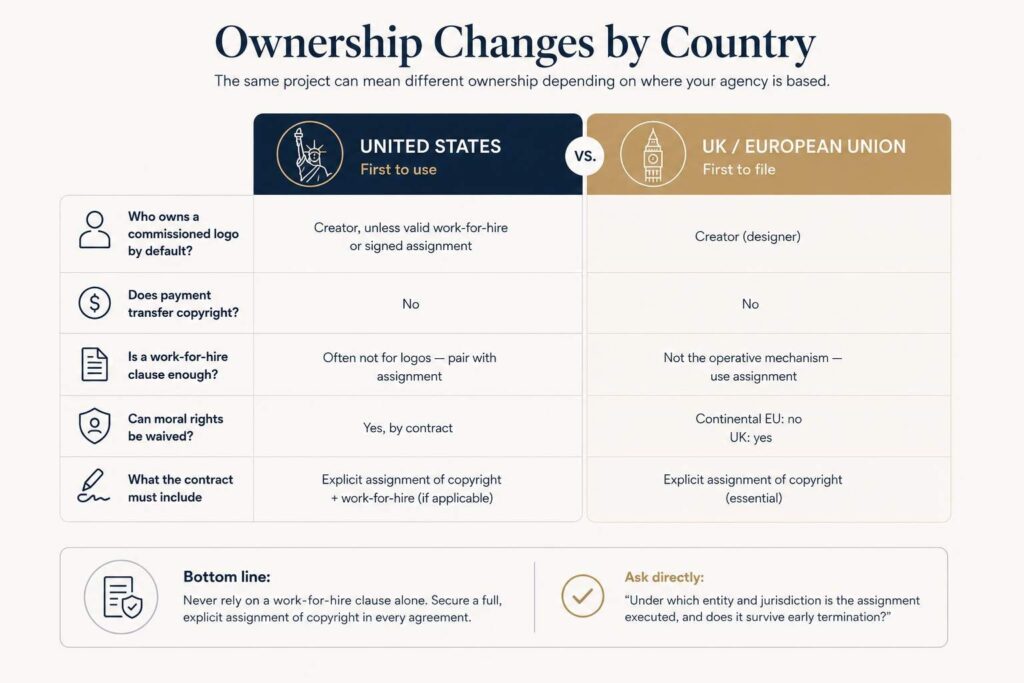
    Ownership changes by country - Infographics

    Every guide says “get your source files.” Almost none warn that the clause protecting your ownership can be legally void — and that the default flips depending on where your designer sits.

    The US work-for-hire trap. Under US copyright law, “work made for hire” only applies to commissioned work if it fits one of nine narrow statutory categories and there’s a signed agreement before creation. A standalone logo often fits none of them. Some mistakenly believe that payment alone — without a written agreement or qualifying employment relationship — confers copyright ownership. It does not. If your contract leans on a work-for-hire clause alone, you may not own what you paid for. Ask for a full, explicit assignment of copyright alongside any work-for-hire language — the assignment is what secures ownership if the designation fails. 

    Europe flips the default. In the UK and EU, the default position is that IP developed by a contractor will generally be owned by the contractor. Absent a written assignment, you typically get only an implied licence to use the work for its original purpose — not to modify, extend, or re-license it. A US-style template used with a European studio can leave you unable to adapt your own brand.

    Moral rights differ too. In continental Europe, moral rights are inalienable and cannot be transferred or waived — a designer can object to distortions of your identity even after selling every economic right. In the UK, Canada, and the US, creators can renounce their moral rights if they choose to. Operating across both regions? This belongs in the contract, not an afterthought. 

    QuestionUnited StatesUK / EU
    Who owns a commissioned logo by default?Creator, unless valid work-for-hire or signed assignmentCreator (designer)
    Does payment transfer copyright?NoNo
    Is a work-for-hire clause enough?Often not for logos — pair with assignmentNot the operative mechanism — use assignment
    Can moral rights be waived?Yes, by contractContinental EU: no; UK: yes

    Ask directly: “Under which entity and jurisdiction is the assignment executed, and does it survive early termination?”

    Trademark clearance, and why region changes the answer

    If naming is in scope, “we checked the domain” isn’t clearance — and neither is a quick database “knockout” search. The USPTO’s own guidance warns that a knockout search misses unregistered common-law marks, which are still enforceable, creating a false sense of security. With millions of active federal registrations and hundreds of thousands of new applications filed each year, collisions are statistically likely.

    The system itself differs by region, which changes what clearance protects:

    Ask: “Who runs clearance, across which databases beyond the domain? Who pays? Are we developing name routes in parallel? If we launch in both the US and EU, how does the clearance and filing sequence change? If a name fails late, what happens to the timeline and cost?” Against a six-figure post-launch conflict, multi-jurisdiction clearance is a rounding error.

    The AI questions almost no one asks yet

    Brand work increasingly uses AI-generated assets, and standard contracts rarely address them. Ask before signing:

    • “Which deliverables involve AI-generated content, and is it disclosed?”
    • “Who owns AI-generated elements — and are they even protectable, or could a competitor use something similar?”
    • “If a tool’s licensing changes, does our right to use those assets survive?”

    Purely AI-generated material can carry weaker ownership protection than human-authored work in several jurisdictions. If your identity leans on it, flag it now, not during a dispute.

    Match your questions to the project

    The right questions change with what you’re buying. Scale the depth to the stakes: a startup should screen for ship-now speed and resist process theater; an enterprise should screen for stakeholder management and rollout, and walk from anyone who can’t handle legal or procurement.

    You’re doing…Ask especially about…The question others skip
    Logo / identity refreshDeliverables, source files, turnaround“Will this survive if we reposition in a year?”
    Full rebrand (stalled growth)Diagnosis, positioning tradeoffs, messaging“What do we stop saying after this?”
    Naming projectClearance ownership, parallel name routes“What happens to the cost if the name fails clearance?”
    New brand from scratchMinimum viable asset set, rules that scale“What do we deliberately not build yet?”
    M&A / architectureSequencing, what carries over vs. retires“How do we avoid two brands inside one org?”

    How to read the answer: 4 evasion tells

    The signal is often in how they answer.

    1. Jargon wall. If they can’t define your positioning in one plain sentence, they may not own the thinking.
    2. Black-box process. No phases, no gates, no named deliverables per stage.
    3. “It depends” with no follow-up. Fine — but a strong operator immediately names the deciding conditions.
    4. Reference friction. Stalling on recent references is the tell, not an inconvenience.

    What a good agency asks you

    A vetting call runs both ways. A strong agency interrogates your side, because a fuzzy brief accepted without pushback predicts fuzzy work. If they don’t ask these, treat it as a red flag on their rigor: How will you measure success? Who is the single decision-maker, and is leadership aligned? What have you already tried that failed? What’s the real budget and timeline?

    Scoring a shortlist

    Comparing two to four agencies? Score them on the same dimensions rather than trusting your memory of who “felt” best — 1 to 5 each: strategy (tradeoffs named), process (defined gates), team (named, accountable), ownership (full assignment + source files, in writing), cross-border readiness (handles US/EU rights if you operate in both), proof (verifiable outcomes). The ownership and cross-border rows are where most agencies quietly lose points — and where standard checklists don’t even look. Total the scores, and the shortlist ranks itself.

    Ready to check a specific agency? Once you know what strong answers look like, validate a real agency against them.

    FAQ

    How many agencies should I shortlist? Three to four — fewer and you lack comparison, more and the scoring turns to noise.

    Should I pay for a discovery or trial phase? Often yes. A paid discovery tests how an agency thinks before you commit to a full engagement; confident operators usually offer one.

    Is it fair to ask who does the junior-level work? Yes. Asking who specifically owns strategy, design, and copy is due diligence, not an insult.

    Do the questions change for a freelancer? Yes — weight capacity and continuity (“what if you’re sick mid-project?”) and confirm they can bring in specialists; for an agency, weight staffing transparency and decision gates.
  • How Much Does Branding Cost in 2026? Real Prices for the USA, Europe and Asia-Pacific — and How to Read a Quote

    How Much Does Branding Cost in 2026? Real Prices for the USA, Europe and Asia-Pacific — and How to Read a Quote

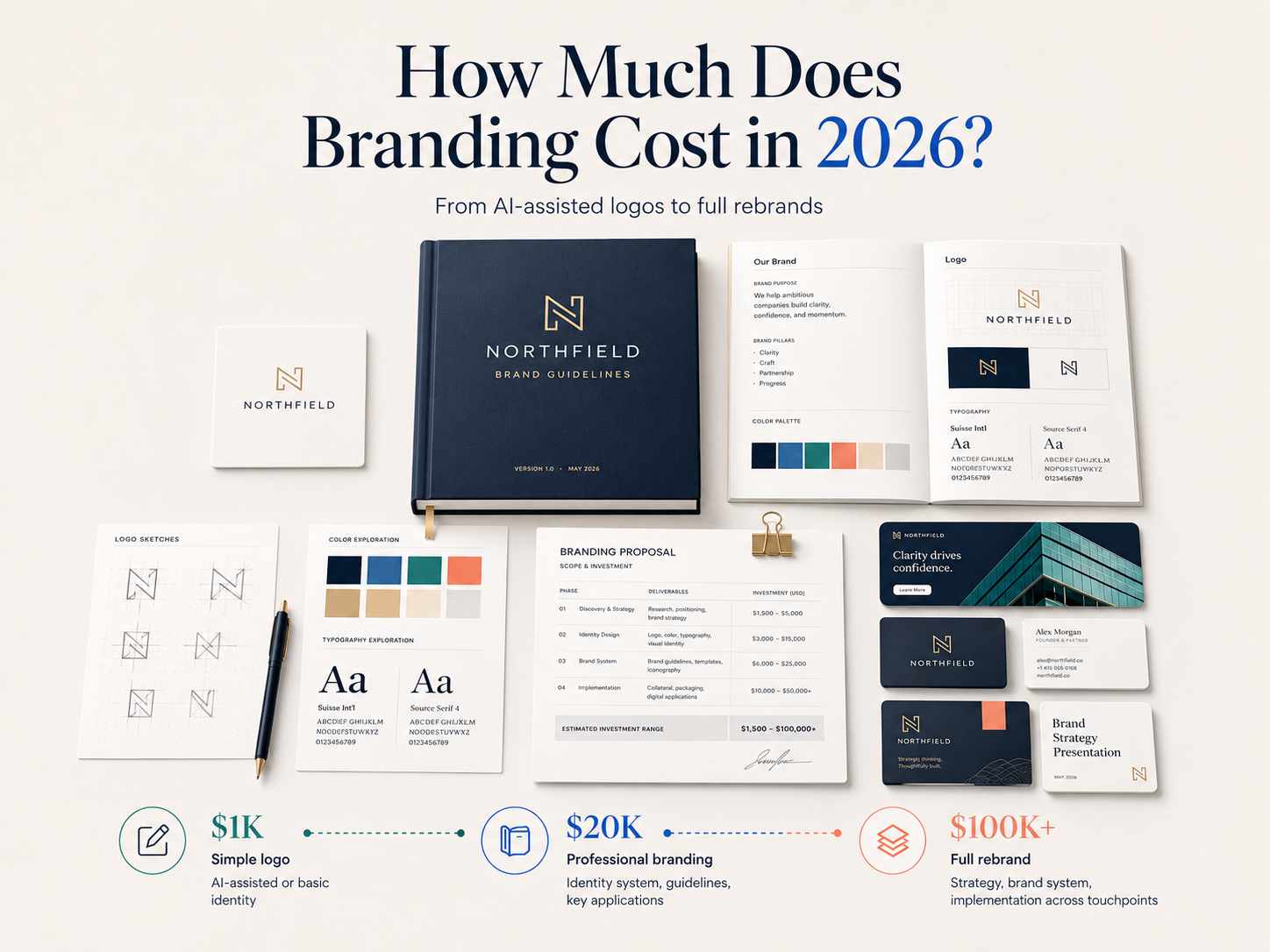
    Quick answer: in 2026, professional branding runs from a few hundred dollars for an AI-assisted logo to six figures for a full rebrand — but the tier is set by your problem, not your revenue. What actually decides your number is four things: the hours of strategy inside the quote, the number of surfaces the brand has to work on, the region you buy in, and whether the price includes ownership of the artwork. This guide gives real 2026 ranges across the USA, Europe and Asia-Pacific, then shows you how to read any quote and spot the two clauses that cost buyers the most when they go missing.

    What branding costs by region: USA, Europe, Asia-Pacific

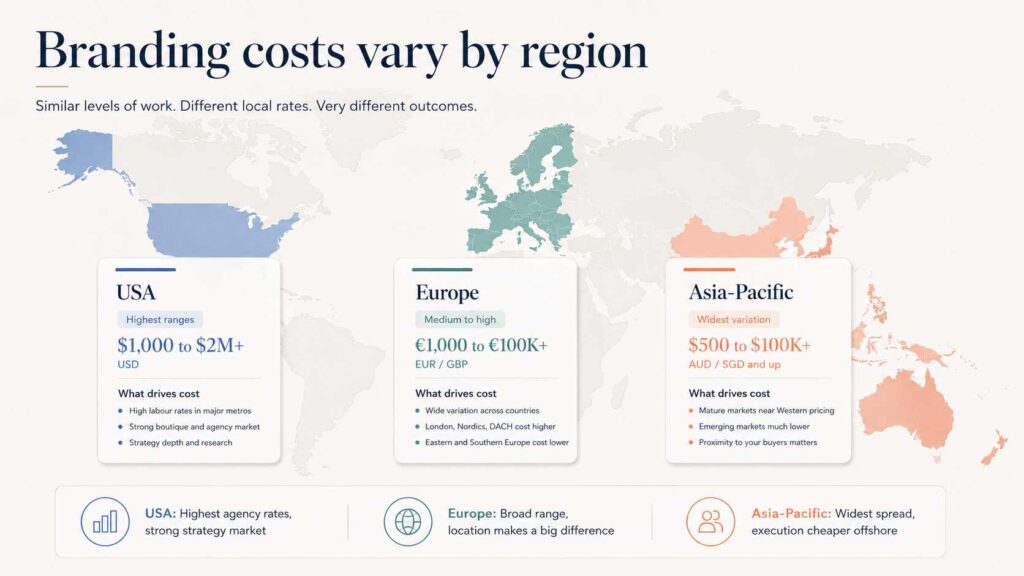
    Most pricing guides answer in US dollars only. If you’re hiring outside the US, that benchmark is off by 30–50%, because local labour rates, agency overhead and even government grants differ. Here are typical 2026 ranges across the three regions where agencies actually cluster. Treat them as planning rails, not quotes — and use the regional shortlists linked below to see who works at each level.

    USA (USD)

    LevelTypical rangeWhat you get
    Freelance / AI-augmented<$1,000–$3,000Logo, basic files, little strategy
    Boutique studio$5,000–$20,000Strategy, identity system, guidelines
    Growth-stage agency$20,000–$70,000Verbal + visual identity, some rollout
    Premium agency$50,000–$200,000+Full brand system, research, campaigns
    Global consultancy$250,000–$2M+Governance-level brand as a managed asset

    Within the US, the metro matters. San Francisco and New York agencies carry the highest overhead and rates; Austin, Denver, Miami, Seattle, Dallas and Houston studios often deliver comparable strategy at a lower sticker. If you’re comparing on location, the city shortlists (New York, San Francisco, Los Angeles, Austin and more on the full US list) show who operates at which tier.

    Branding cost vary by region - Infographics

    Europe (GBP / EUR)

    Europe has no single benchmark, so use the UK — the region’s most transparent market — as your anchor, then adjust. In the UK, a logo runs £500–£3,000, a logo-plus-guidelines starter pack £1,500–£5,000, a full identity with strategy £5,000–£20,000, and a complete rebrand £10,000–£50,000+. London runs higher: basic branding £4,000–£10,000, a full system £10,000–£35,000, premium work with rollout £35,000–£100,000+. Cross-check any quote against the day rate — the Design Council UK puts mid-to-senior freelance brand designers at £500–£900 per day in 2026, with agencies at £75–£150+ per hour.

    Adjust from that anchor across the continent: the Nordics and DACH region (Germany, Austria, Switzerland) run higher than the UK; Southern and Eastern Europe lower, which is why offshore execution often routes there. See the European agency shortlist for who works at each level.

    Asia-Pacific (AUD / SGD and up)

    APAC is the widest region — mature markets like Australia and Singapore price near Western levels, while emerging markets run far lower.

    Australia (AUD): brand design runs $1,500–$50,000+; a logo is $500–$2,800 freelance and $2,800–$14,500 at an agency; a full SMB identity system $3,000–$15,000. The AGDA 2024 survey puts the median rate at $130–$180/hour, with a logo needing 15–30 hours. Two local modifiers: Sydney and Melbourne carry a 15–25% premium over regional teams, and rush timelines add 20–30%.

    Singapore (SGD): branding spans SGD 5,000–100,000+, with the SME sweet spot at SGD 10,000–35,000 for strategy, identity and guidelines together. The factor most buyers miss is funding — branding and marketing-strategy projects can qualify for support under the Enterprise Development Grant (EDG). One local guide illustrates it as roughly SGD 6,000–14,000 back on a SGD 20,000 project, but support levels change, so confirm current eligibility with Enterprise Singapore before signing.

    Across APAC the split holds: mature-market strategy prices near the West; emerging-market execution is cheaper, but proximity to your buyers is what you pay for in strategy. See the Asia-Pacific shortlist for agencies across the region.

    The structure of pricing is the same everywhere — a strategy tier, a system tier, an enterprise tier — but the floor and ceiling move with local labour cost. Offshore teams can compress the execution line; they can’t compress strategy.

    How to read a branding quote (hours × rate)

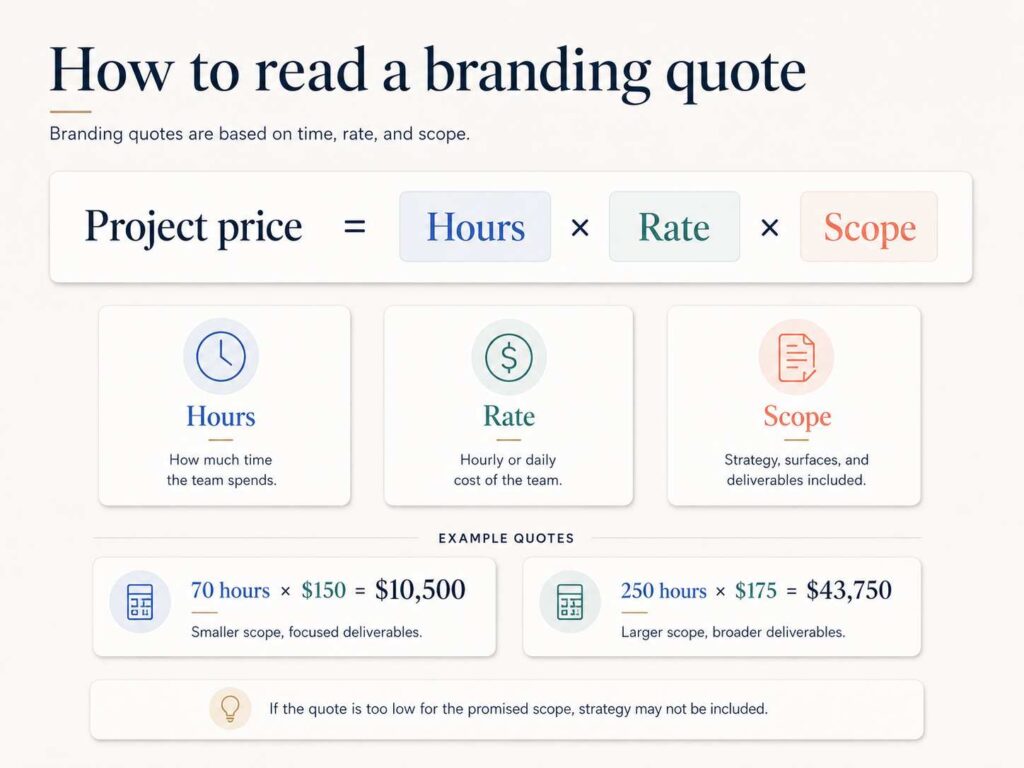
    Every branding price is, underneath, hours of skilled time × a rate. Once you see that, an opaque proposal becomes readable.

    How to read a branding quote - Infographics

    Benchmarks make it concrete. A surface-level identity of roughly 60–80 hours prices at about £5,000–£20,000; a research-led identity of 200–300+ hours prices at £20,000–£50,000+. Put a rate against it — the AGDA median of $130–$180 AUD/hour, or the UK £500–£900/day — and you can sanity-check any figure. If a quote promises “full brand identity with strategy” but the price only covers three or four professional days, the strategy isn’t in there; you’re buying execution and supplying the thinking yourself.

    Ask three questions of any proposal:

    1. How many hours, and who does them? At large agencies, senior people sell and junior people deliver; at boutiques, the strategist who pitches usually does the work. Ask who is actually on the tools. (This is also why our methodology weights strategic fit, not just polish.)
    2. What’s the split between strategy and execution? A quote that’s 90% design and 10% discovery is a visual job — right if you already know your positioning, wrong if you’re trying to fix pricing power or slow sales cycles.
    3. How many surfaces does it cover? A brand that only lives on a website is cheaper than one that must work on a website, product UI, decks, packaging and signage. Each surface is scope — and it’s where cheaper quotes quietly drop the expensive part.

    If a proposal doesn’t itemise scope, the price tells you almost nothing — and that opacity is itself the signal.

    Who owns the logo after you pay?

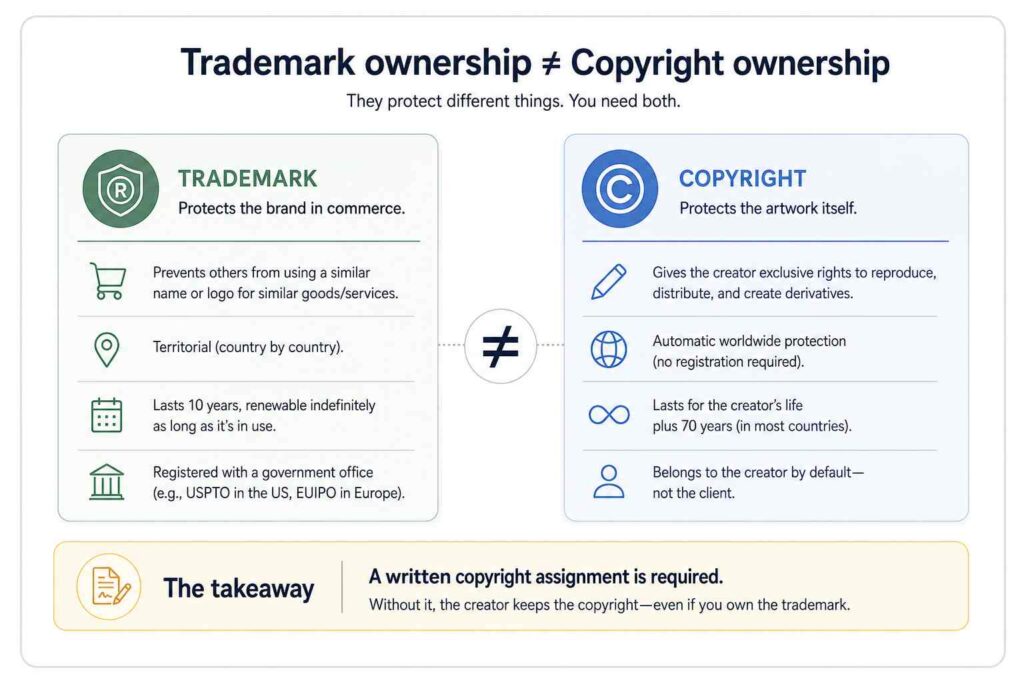
    This is the most expensive thing almost no pricing guide mentions: paying for a logo does not, by default, make you its legal owner.

    Under US and UK copyright law, the creator owns the copyright unless there’s a written assignment. Hiring and paying a freelancer or agency does not transfer that copyright automatically — you get only an implied licence, whose scope is undefined and disputable (Sul Lee Law; LegalGPS). The “work made for hire” label many contracts lean on is narrower than people assume: in the US its categories don’t cleanly cover a commissioned logo, and in some states (California, for one) applying that label to a contractor can reclassify them as an employee (Sul Lee Law).

    The consequence is counter-intuitive: you can own the trademark and still not own the drawing. Trademark rights come from use; copyright in the artwork stays with the creator absent an assignment. Without it you may be unable to modify the logo, switch vendors, register valid design rights, or sell the business cleanly — and a missing copyright assignment on brand artwork is a classic issue that stalls investor due diligence.

    Trademark ownership vs copywrite ownership - Infographics

    The fix costs nothing: before work begins, require the contract to include a written assignment of the artwork’s copyright (not just “you’ll receive the files”), transferring on final payment. Get the assignment of the design, not merely a PNG. This one clause is worth more than a round of revisions. (This is general information, not legal advice — confirm wording with an IP lawyer in your jurisdiction.)

    What’s not in the price

    Trademark registration is the clearest example, and it’s never part of the design fee — it’s a separate legal process with its own government fee. In the US, the USPTO charges $350 per class of goods or services (USPTO); other offices (UK IPO, EUIPO, IPOS) publish their own per-class fees. Beyond that, the costs that blow budgets usually sit outside scope: font and stock licences (recurring or per-seat); rollout and production — signage, packaging, print, vehicle graphics — which is often larger than the design itself; the website build; photography and video production; and your own internal hours briefing, deciding and training staff to use the brand. Ask which of these the quote includes. The gap between “brand identity” and “brand in market” is where surprise spend lives.

    What AI did to the price in 2026

    AI has compressed branding pricing harder than any other digital service — but unevenly. On the SMB side, logo and visual-production work has dropped an estimated 70–90% in 18 months. Strategy, naming and rebrands have barely moved, because they depend on human judgement. A new tier has appeared between DIY tools and agencies: AI-augmented fixed-price platforms (roughly $499–$2,999) using AI for exploration and a human designer for direction.

    Two cautions. Pure AI-tool output — no human in the loop — tends to be generic and derivative: fine for a placeholder, risky for a business that needs to stand out. And a logo produced with no trademark clearance is a liability, not an asset; AI-generated marks frequently fail the distinctiveness test needed for protection. The floor dropped; the premium for genuinely original, ownable identity widened.

    The price tiers, compressed

    You still need the ladder — just don’t mistake it for the answer. Four tiers recur across markets:

    TierWhat it buysRight for
    Freelance / AI-augmentedLogo + light identityClear brief, tight budget
    Boutique studioStrategy, full identity, guidelinesSMBs scaling up
    Mid / growth agencyVerbal + visual system, research, rolloutRepositioning, crowded markets
    Premium / globalBrand architecture, governance, multi-marketEnterprise, post-merger

    The tier you need is set by the problem, not your revenue. A well-funded startup with a clear direction may correctly buy freelance; a bootstrapped firm fighting for pricing power may correctly buy a strategy it can barely afford.

    Does your industry change the price?

    Yes — regulated and complex sectors cost more because they add compliance review, longer research and more stakeholders. Fintech, healthcare and enterprise software sit at the top of the range for a given tier; consumer and local-service brands sit lower. Web3 and AI brands pay a premium for specialist agencies fluent in the category, where the visual language and buyer expectations are still forming. If your sector is the deciding factor, start from an industry-specific shortlist (fintech, SaaS, healthcare, Web3 & crypto) rather than a general one — sector fluency shortens the research phase and reduces expensive misunderstandings.

    Red flags: when cheap is a trap and expensive is justified

    Signs the cheap quote costs more later: a “full brand identity” priced below a few professional days (execution, no strategy); no discovery or positioning (design becomes subjective and gets reworked within 12–18 months); an AI-only logo with no trademark check (possibly un-ownable); no copyright assignment in the contract (you don’t own what you paid for).

    Signs the expensive quote is worth it: hours that map to real strategy (200–300+ for research-led identity), itemised; verbal identity in scope, not just visuals; the strategist who presents is the one doing the work; coverage of the surfaces you actually operate on.

    Signs you’re overpaying: buying global-consultancy overhead for an SMB problem, or paying for surfaces you won’t use for two years.

    One cost-of-error note: a rebrand typically runs two to three times a cheap original logo, plus re-applying the identity to every asset already in circulation. The business that spent £300 on a marketplace logo isn’t facing a £300 upgrade later — it’s a £2,500–£5,000 replacement plus rollout. Getting the tier right the first time is almost always cheaper than fixing it.

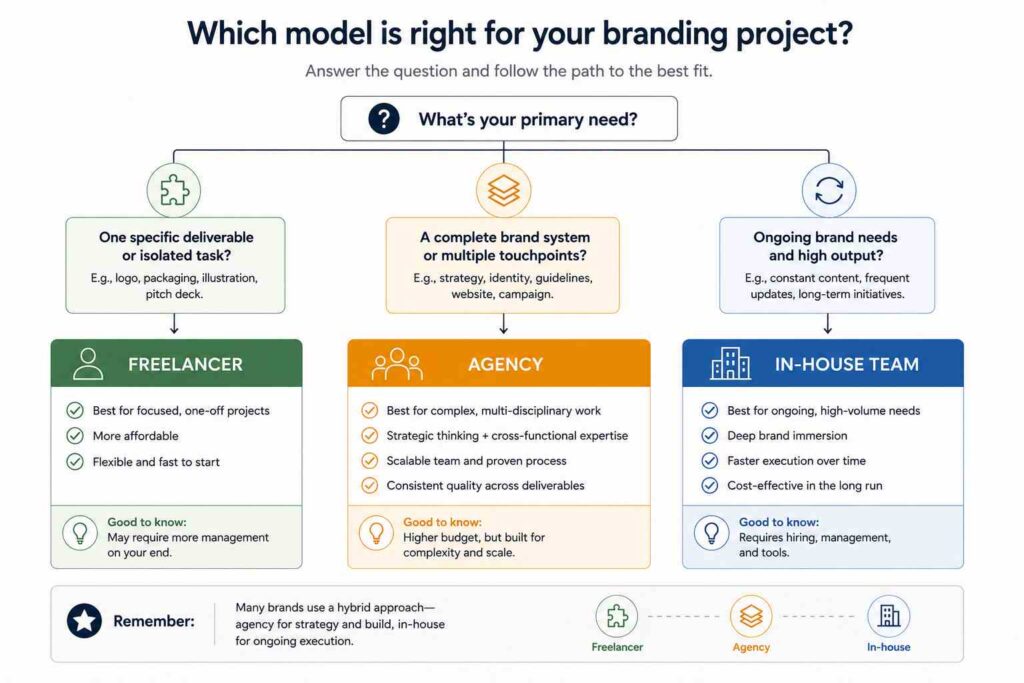
    In-house vs freelancer vs agency: the real cost

    Which model is right for your branding project - Infographics
    RouteSticker costHidden costBest when
    In-house creative director~£100,000+/yearRecruitment, management, benchingContinuous, high-volume brand work
    Freelancer30–50% below agencyOne perspective, lighter strategy, you manage rolloutClear brief, single deliverable
    AgencyHighest stickerProcess overhead, coordinationBrand must work across many surfaces

    An in-house hire only pays off with steady volume; for a one-off build it’s the most expensive per project. A freelancer is often the better choice for SME identity work — your project gets a senior designer throughout instead of being passed to juniors. An agency earns its fee the moment consistency across many touchpoints becomes the hard part.

    How to spend less without gutting the outcome

    Cut the invoice, not the strategy. Phase it: buy the core first — logo, palette, typography, logo rules, a short guideline PDF — and defer signage, packaging and extended collateral until you need them. Appoint one decision-maker: revision creep is a top cost driver, and too many voices produce weak branding and a bigger bill. Bundle brand and website: splitting them across two vendors adds a coordination tax and a cohesion gap. Use available funding (Singapore’s EDG is the clearest case). Don’t cut strategy or the copyright assignment — those are the parts that are expensive to fix later.

    Budget over 12–36 months (total cost of ownership)

    The project fee is the start, not the total. Brands are refreshed every 3–5 years (some sectors stretch to 5–10), so budget for evolution, not a one-off. Recurring costs include font and template licences, guideline updates, internal rollout labour and trademark maintenance. As a rough sizing cross-check — not a rule to design around — many firms allocate around 10% of marketing spend to branding; let scope, not the percentage, set the final figure.

    FAQ

    How long does a branding project take?
    A focused logo-and-identity project runs about 4–8 weeks; a full identity with strategy and a website, 12–24 weeks; enterprise or post-merger work, months. Compressing these triggers the rush surcharge (typically +20–50%), because research gets cut first.

    Is it normal to pay in stages?
    Yes. Most agencies bill a deposit (commonly 30–50%) to start, then milestone payments at strategy sign-off, concept approval and final delivery. Be wary of 100%-upfront terms and of pay-only-at-the-end — both push all the risk onto one party.

    What happens to the price if I change the brief mid-project?
    Scope changes are the most common overrun. A new direction after concepts are approved usually re-opens paid hours. Lock the brief before design starts, and ask how change requests are priced — hourly, or re-quoted.

    Should I register the trademark before or after the design?
    Run an availability check before commissioning, so you don’t build on a name or mark that’s taken. Register after the artwork is final — and only once the copyright assignment is in your contract, since you generally need to own the mark to protect it.

    Should I hire locally or go with a global agency?
    Both work — it depends on the job. A local or regional agency understands your market and buyers, which matters most for positioning; a global network buys scale and multi-market rollout. Match the choice to the transition you’re navigating, not to the biggest name. Our regional shortlists (USA, Europe, Asia-Pacific) are grouped this way for exactly this reason.

    Do cheaper offshore teams produce worse brands?
    Not for execution — offshore studios deliver competent visual work at lower cost. What proximity buys is strategy. Offshore for production, local for positioning is a defensible split.